经过initialize的一次性配置和before_trading_start的每日盘前准备本文将详细讲解承载所有核心交易逻辑的函数handle_data()这个函数
1. handle_data(context, data) 函数的核心定位
handle_data()函数会在交易时段内,根据我们设定的频率(按天或按分钟)被平台周期性地反复调用
策略所有的行情分析、信号判断、交易决策和下单执行,都集中在这个函数内完成可以说,策略的绝大部分运行时长,都在handle_data的循环调用中度过
2. handle_data 的两大核心参数
handle_data函数带有两个至关重要的参数:context和data,它们是策略决策的数据基础
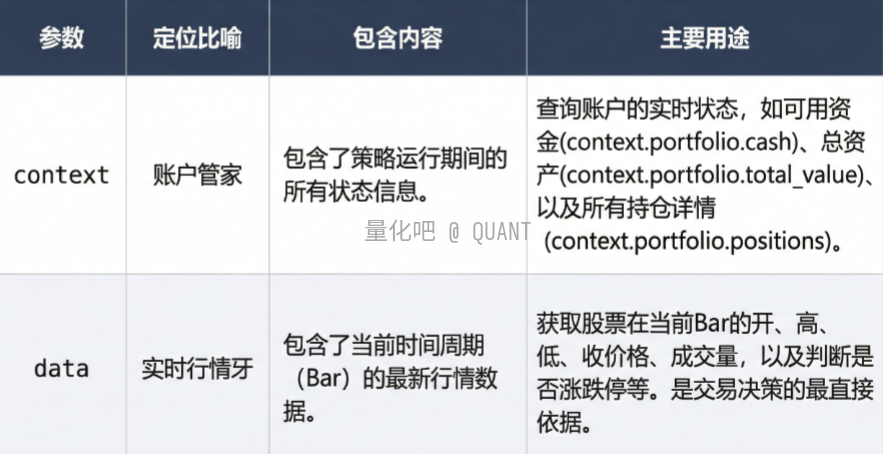
3. handle_data 的标准工作流
为了方便学习使用一个逻辑清晰的handle_data函数;我们可以遵循以下四步走。这有助于构建出结构稳定、易于维护的策略
1 数据获取:根据策略需要,获取用于计算指标的历史数据(如使用get_history),以及用于决策的当前价格(直接从data对象获取)
2 信号生成:基于获取的数据,进行指标计算(如均线、MACD),并根据预设的交易逻辑判断是否产生了买入或卖出信号
3 持仓判断:在产生交易信号后,需要检查当前的持仓状态(如使用context.portfolio.positions或get_position),以决定下一步是该开仓加仓、减仓还是清仓
4 执行下单:根据信号和持仓状态,调用下单函数(如order、order_target)执行最终的交易操作
4. 完整的 handle_data 代码示例(双均线策略)
下面的代码完整地演示了在一个handle_data函数中,如何实现一个经典的双均线(金叉买入,死叉卖出)策略
def initialize(context):
    set_benchmark("000300.SS")

    try:
        set_commission(commission_ratio=0.0003, min_commission=5.0, type="STOCK")
        set_slippage(slippage=0.0024)
    except Exception as e:
        log.info(f"提示:当前环境可能不支持 set_commission/set_slippage:{e}")

    g.security_list = ["600519.SS", "000001.SZ"]
    set_universe(g.security_list)

    g.short_ma_period = 10
    g.long_ma_period = 30

    g.traded_today = False
    g.today_options = list(g.security_list)
    g._last_debug_day = None

    log.info("策略初始化完成。")


def before_trading_start(context, data):
    g.traded_today = False

    dt = getattr(context, "current_dt", None)
    date_str = dt.strftime("%Y-%m-%d") if dt else "unknown_date"
    log.info(f"进入交易日 {date_str},重置每日状态。")

    sec_list = getattr(g, "security_list", None) or ["600519.SS", "000001.SZ"]
    g.security_list = sec_list

    g.today_options = []

    try:
        hist = get_history(1, "1d", "close", security_list=sec_list, fq=None, include=False)
    except TypeError:
        hist = get_history(1, frequency="1d", field="close", security_list=sec_list, fq=None, include=False)

    if hist is None:
        g.today_options = list(sec_list)
    else:
        close_map = None
        try:
            import pandas as pd
            if isinstance(hist, pd.DataFrame):
                cols = set(hist.columns)
                if ("code" in cols) and ("close" in cols):
                    m = {}
                    for s in sec_list:
                        x = hist.loc[hist["code"] == s, "close"]
                        if len(x) > 0:
                            m[s] = float(x.iloc[-1])
                    close_map = m
                elif all(s in cols for s in sec_list):
                    close_map = {s: float(hist[s].iloc[-1]) for s in sec_list}
            elif isinstance(hist, pd.Series):
                close_map = {sec_list[0]: float(hist.iloc[-1])}
        except Exception:
            close_map = None

        if close_map is None:
            g.today_options = list(sec_list)
        else:
            for s in sec_list:
                if s in close_map and close_map[s] > 20:
                    g.today_options.append(s)
            if not g.today_options:
                g.today_options = list(sec_list)

    log.info(f"今日备选股票池: {g.today_options}")
    log.info(f"盘前可用资金: {context.portfolio.cash:.2f}")


def _extract_close_series(hist, security):
    try:
        import pandas as pd
        if isinstance(hist, pd.Series):
            return hist.dropna()
        if isinstance(hist, pd.DataFrame):
            cols = set(hist.columns)
            if ("code" in cols) and ("close" in cols):
                return hist.loc[hist["code"] == security, "close"].dropna()
            if security in cols:
                return hist[security].dropna()
            if "close" in cols:
                return hist["close"].dropna()
    except Exception:
        pass

    try:
        return hist["close"][security].dropna()
    except Exception:
        return None


def handle_data(context, data):
    sec_list = getattr(g, "security_list", None) or ["600519.SS", "000001.SZ"]
    g.security_list = sec_list

    short_n = int(getattr(g, "short_ma_period", 10))
    long_n = int(getattr(g, "long_ma_period", 30))
    if not (0 < short_n < long_n):
        log.info("均线参数不合法:要求 0 < short < long。")
        return

    candidates = getattr(g, "today_options", None) or sec_list
    if not candidates:
        return
    security = candidates[0]

    try:
        hist = get_history(long_n + 1, "1d", "close", security_list=security, fq=None, include=False)
    except TypeError:
        hist = get_history(long_n + 1, frequency="1d", field="close", security_list=security, fq=None, include=False)

    if hist is None:
        return

    close = _extract_close_series(hist, security)
    if close is None or len(close) < long_n + 1:
        log.info(f"{security} 历史数据不足或解析失败,跳过。")
        return

    s_ma_t = close.iloc[-short_n:].mean()
    l_ma_t = close.iloc[-long_n:].mean()

    close_prev = close.iloc[:-1]
    s_ma_prev = close_prev.iloc[-short_n:].mean()
    l_ma_prev = close_prev.iloc[-long_n:].mean()

    golden_cross = (s_ma_prev  l_ma_t)
    death_cross = (s_ma_prev >= l_ma_prev) and (s_ma_t < l_ma_t)

    pos = get_position(security)
    pos_amount = getattr(pos, "amount", 0) or 0

    dt = getattr(context, "current_dt", None)
    d = dt.date() if dt else None
    if getattr(g, "_last_debug_day", None) != d:
        g._last_debug_day = d
        log.info(
            f"{security} | s_prev={s_ma_prev:.3f}, l_prev={l_ma_prev:.3f}, "
            f"s={s_ma_t:.3f}, l={l_ma_t:.3f} | "
            f"golden={golden_cross}, death={death_cross} | pos_amount={pos_amount}"
        )

    try:
        current_price = data[security].price
    except Exception:
        try:
            current_price = data[security]["close"]
        except Exception:
            current_price = None

    target_amount = 100

    if golden_cross and pos_amount == 0:
        delta = target_amount - pos_amount
        if delta != 0:
            if current_price is not None:
                oid = order(security, delta, limit_price=current_price)
            else:
                oid = order(security, delta)
            log.info(f"金叉下单:{security} delta={delta} price={current_price} order_id={oid}")
            g.traded_today = True

    elif death_cross and pos_amount > 0:
        delta = -pos_amount
        if current_price is not None:
            oid = order(security, delta, limit_price=current_price)
        else:
            oid = order(security, delta)
        log.info(f"死叉下单:{security} delta={delta} price={current_price} order_id={oid}")
        g.traded_today = True
5. 注意事项
• 执行频率:handle_data的执行频率(日或分钟)对策略行为有决定性影响。分钟级策略反应更灵敏,但交易可能更频繁;日级策略则更关注长期趋势
• 避免重复交易:一个交易信号可能会在连续多个分钟Bar内持续满足条件。需要设计逻辑(如使用g.traded_today标记)来避免在同一信号下重复下单
• 数据完备性:在调用get_history获取数据时,应检查返回的数据长度是否满足计算指标的要求,避免因数据不足导致计算错误
handle_data是策略实现价值的核心所在。通过“数据获取 -> 信号生成 -> 持仓判断 -> 执行下单”的标准化流程,
我们便可以逻辑清晰的将复杂的交易思想,转化为清晰、可执行的代码
PTrade免费申请
PTradeQMT免费领取学习案例
PTradeQMT落地辅助
需要的朋友欢迎联系 ~~~

